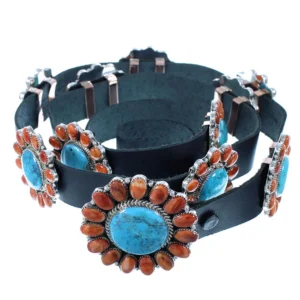
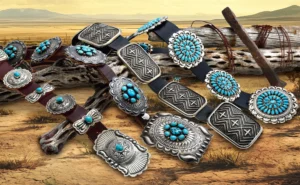
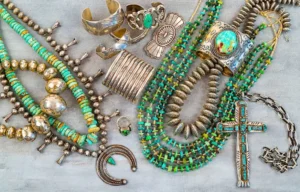
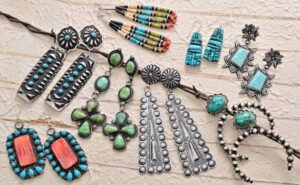
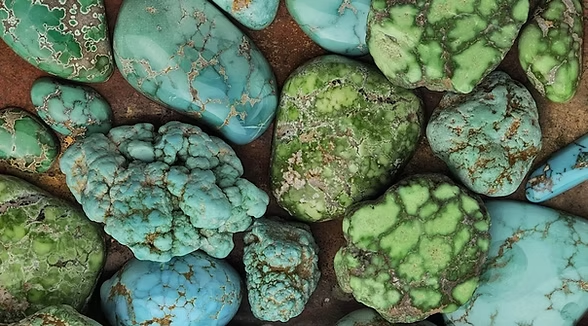
The story of Native American jewelry began long before precious metals became part of artistic expression. Across North America, Indigenous communities created ornaments using materials gathered from their surrounding environments, including shell, bone, wood, stone, seeds, antler, copper, and naturally occurring minerals. These early adornments reflected remarkable ingenuity, demonstrating an intimate understanding of the natural world and the ability to transform ordinary materials into objects of beauty through carving, drilling, polishing, weaving, and careful assembly. Rather than existing solely for decoration, these creations often reflected identity, artistic expression, community traditions, and regional craftsmanship, illustrating that jewelry has long held an important place within Indigenous artistic life.
The diversity of these early materials also reveals how geography influenced artistic development. Coastal communities incorporated marine shell and other ocean resources, while communities living in arid landscapes worked with turquoise, stone, and locally available minerals. This relationship between environment and craftsmanship established a principle that continues to define Native American jewelry today: artisans create with deep respect for the natural materials available to them. Long before sterling silver transformed Southwestern jewelry, these early traditions had already established the creativity, technical skill, and artistic vision that would shape future generations.
A Turning Point That Changed Southwestern Jewelry Forever
One of the most significant developments in the history of Native American jewelry occurred during the nineteenth century with the introduction and adaptation of silversmithing techniques in the American Southwest. Rather than replacing existing artistic traditions, metalworking expanded the creative possibilities available to Native artisans. Sterling silver offered durability, versatility, and an entirely new medium through which decorative ideas could be expressed. As silversmiths refined their understanding of forging, soldering, engraving, and shaping precious metal, jewelry evolved into increasingly sophisticated forms that combined traditional artistic values with innovative craftsmanship.
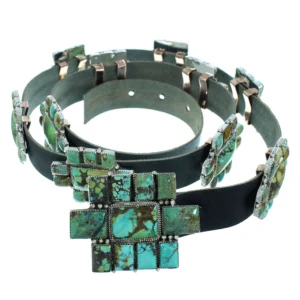
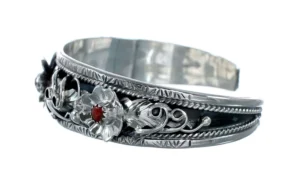
This transformation was not immediate but developed gradually as knowledge passed from one artisan to another. Over time, handcrafted silver bracelets, necklaces, rings, pendants, earrings, belt buckles, and ceremonial jewelry emerged with distinctive regional characteristics that reflected both technical advancement and individual artistic interpretation. These developments marked the beginning of a silversmithing tradition that would eventually become one of the defining achievements of Native American decorative arts.
The Rise of Distinct Artistic Traditions
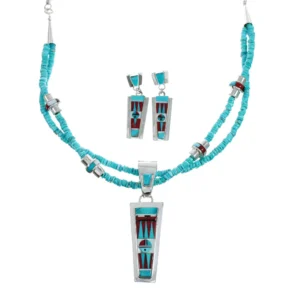
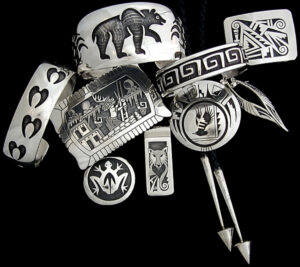
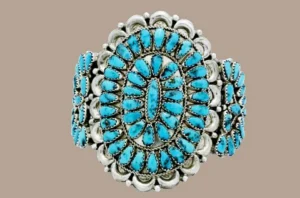
As Native American silversmithing continued to develop, different communities refined their own artistic approaches, creating traditions that remain internationally respected today. Navajo silversmiths became celebrated for bold sterling silver craftsmanship, substantial forms, and exceptional turquoise jewelry. Zuni artisans elevated lapidary techniques through intricate stone inlay, needlepoint, petit point, and carefully balanced mosaic compositions. Hopi artists introduced sophisticated overlay silverwork distinguished by symbolic imagery, architectural precision, and remarkable artistic restraint. Each tradition evolved according to its own creative philosophy while contributing to the extraordinary diversity that defines Native American jewelry as a whole.
Although these traditions are often discussed individually, their shared commitment to craftsmanship remains their strongest connection. Every artistic community developed methods that reflected local knowledge, available materials, and generations of accumulated experience. Appreciating these distinctions allows collectors and enthusiasts to recognize Native American jewelry not as a single artistic style but as a rich collection of independent yet interconnected creative traditions that continue to evolve through contemporary artisans.
From Regional Craftsmanship to International Recognition
During the twentieth century, appreciation for Native American jewelry expanded far beyond the American Southwest. Collectors, museums, historians, galleries, and cultural institutions increasingly recognized handcrafted Native American jewelry as an important form of artistic achievement rather than simply regional craftsmanship. Exhibitions, publications, and private collections introduced wider audiences to the remarkable technical ability of Native American silversmiths, while growing demand encouraged continued innovation without abandoning traditional methods.
As recognition increased, Native American jewelry also became more visible within the broader world of fine jewelry and decorative arts. Its distinctive combination of handcrafted silverwork, natural gemstones, and cultural artistry established a lasting reputation for originality and quality. Today, authentic Native American jewelry is appreciated internationally, not because it follows changing fashion trends, but because it represents enduring craftsmanship rooted in generations of artistic excellence.
A Living Tradition That Continues to Evolve
The history of Native American jewelry is not confined to museums or historical collections. It continues to develop through contemporary artists who honor traditional craftsmanship while exploring new creative ideas, materials, and design approaches. Modern silversmiths continue to forge sterling silver by hand, shape natural gemstones with exceptional care, and create jewelry that reflects both personal artistic vision and respect for established traditions. This balance between continuity and innovation ensures that Native American jewelry remains a living art form rather than a historical artifact.
For collectors and enthusiasts, understanding this ongoing evolution adds a deeper dimension to every handcrafted piece. A contemporary bracelet, pendant, ring, or necklace is connected to centuries of artistic knowledge while expressing the creativity of today’s artisans. Recognizing this continuity transforms the appreciation of Native American jewelry from admiration of beautiful objects into an understanding of an enduring artistic legacy that continues to inspire new generations.
Looking Back to Better Appreciate the Present
Every piece of Native American jewelry carries traces of a much larger story—one shaped by changing materials, evolving craftsmanship, regional traditions, and generations of artistic dedication. Understanding this history allows collectors and admirers to see beyond polished silver and natural gemstones, recognizing instead the remarkable journey that has brought Native American jewelry to its respected place within the world of decorative arts.
As you continue exploring our Learning Center, you’ll discover how this historical foundation connects naturally with tribal traditions, gemstone knowledge, silversmithing techniques, authenticity, collecting, and the enduring craftsmanship behind every handcrafted creation. The past provides context for the present, making every piece of Native American jewelry more meaningful through the knowledge of how this extraordinary artistic tradition came to be.