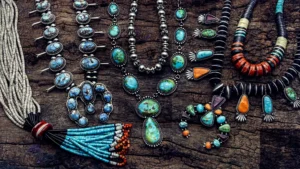
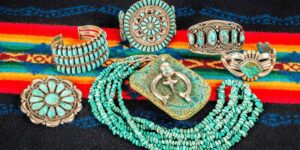
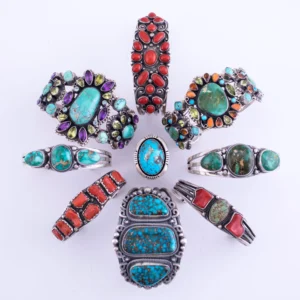
One of the most common misconceptions surrounding Native American jewelry is the belief that authenticity can be confirmed simply by finding a hallmark or a stamped signature. While hallmarks can provide valuable information, they represent only one part of a much broader evaluation process. Experienced collectors, museum professionals, appraisers, and knowledgeable buyers understand that authenticity is determined by examining the complete relationship between craftsmanship, materials, construction, artistic style, and documented information where available. A hallmark may identify an artist or indicate sterling silver, but it cannot, by itself, guarantee quality, artistic merit, or the complete history of a piece.
Authentic Native American jewelry is better understood as the result of skilled craftsmanship combined with thoughtful design and appropriate materials. The quality of silverwork, the precision of stone settings, the balance of proportions, the integrity of construction, and the consistency of finishing all contribute to an informed evaluation. Learning to observe these characteristics helps buyers move beyond simple assumptions and develop the confidence to appreciate handcrafted jewelry based on its complete artistic and technical qualities.
Understanding Hallmarks Without Misunderstanding Their Purpose
Hallmarks have become an important part of identifying many pieces of contemporary Native American jewelry, but their role is often misunderstood. Depending on the artist, workshop, and period in which a piece was created, a hallmark may consist of initials, a personal signature, a unique maker’s mark, or a combination of identifying symbols. Some pieces may also include markings such as “Sterling” or ”.925,” indicating the silver alloy used in the jewelry. These markings provide useful information, but they should always be interpreted alongside the overall craftsmanship of the piece rather than treated as proof on their own.
It is equally important to recognize that not every authentic piece carries a hallmark. Earlier works, smaller studio productions, and some handcrafted jewelry may be unsigned for a variety of legitimate reasons. Likewise, the presence of a hallmark does not automatically establish provenance, quality, or authorship. Responsible evaluation considers hallmarks as one valuable source of information within a much broader assessment that includes construction techniques, design characteristics, documented provenance where available, and the reputation of the maker or seller.
The Craftsmanship That Experienced Collectors Notice First
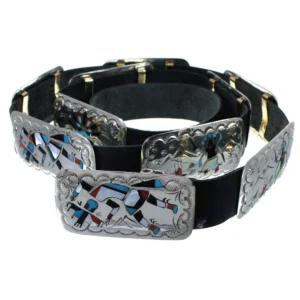
Long before examining a signature or reading a product description, experienced collectors usually begin by studying the workmanship itself. Handcrafted Native American jewelry reveals its quality through countless small details that work together to create a balanced and durable piece. Clean solder joints, carefully shaped bezels, consistent decorative stamping, refined engraving, symmetrical layouts, secure gemstone settings, smooth finishing, and thoughtful proportions all demonstrate the patience and technical discipline invested throughout the fabrication process. These details rarely attract immediate attention from casual observers, yet they often provide the clearest evidence of exceptional craftsmanship.
The reverse side of a piece can be just as informative as the front. Experienced buyers often examine hidden areas for evidence of careful finishing, structural integrity, and attention to detail. Well-executed handcrafted jewelry typically reflects the same level of care throughout the entire piece rather than concentrating workmanship only where it is most visible. This commitment to quality distinguishes thoughtfully crafted jewelry from mass-produced alternatives and explains why exceptional workmanship remains one of the most reliable indicators of lasting value.
Materials Matter Just as Much as Workmanship
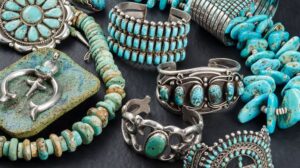
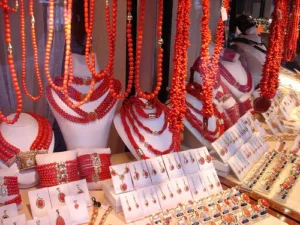
The quality of Native American jewelry depends not only on the artisan’s skill but also on the materials selected for each design. Sterling silver has earned its reputation because it offers an excellent balance of strength, durability, and workability, allowing silversmiths to create intricate designs while maintaining structural integrity. Natural materials such as turquoise, coral, spiny oyster shell, jet, lapis lazuli, mother of pearl, onyx, and other gemstones each possess unique characteristics that influence both appearance and long-term performance. Appreciating these materials requires understanding their natural variations rather than expecting every stone to appear identical.
Buyers may also encounter descriptions referring to natural, stabilized, treated, or composite materials. These terms describe different characteristics or preparation methods and should be explained accurately by reputable sellers. Understanding what these descriptions mean allows collectors to make informed decisions based on transparent information rather than assumptions. Knowledgeable buying begins with asking questions, reading descriptions carefully, and seeking clarity whenever important details are not fully explained.
Questions Knowledgeable Buyers Commonly Ask
Confident collecting is rarely the result of impulse. Experienced buyers develop the habit of asking thoughtful questions that provide a clearer understanding of the jewelry they are considering. They often seek information about the materials used, the craftsmanship involved, artist attribution where available, the dimensions and construction of the piece, and any documentation that accompanies it. They also pay attention to the accuracy of product descriptions, the quality of photography, return policies, and the willingness of a seller to answer reasonable questions openly and professionally.
These habits are valuable regardless of where jewelry is purchased. They encourage transparency, reduce misunderstandings, and help buyers develop greater confidence in evaluating handcrafted work. Over time, these questions become second nature, allowing collectors to appreciate not only the finished jewelry but also the expertise required to create and present it responsibly.
Education Is the Most Reliable Standard of All
The most valuable tool available to any collector is knowledge. Hallmarks, sterling silver markings, artist signatures, gemstones, and craftsmanship all become easier to understand through careful study and continued experience. Every piece of Native American jewelry presents an opportunity to observe, compare, and learn, gradually developing the ability to recognize quality through informed observation rather than assumption. This educational approach strengthens appreciation for the remarkable artistry that defines Native American jewelry while encouraging thoughtful collecting built on understanding rather than speculation.
Throughout the Squash Blossom Treasures Learning Center, we encourage readers to continue exploring the many aspects of Native American jewelry, including tribal traditions, gemstone knowledge, traditional silversmithing, collecting practices, historical development, and jewelry care. The more you learn about the artistry behind every handcrafted piece, the more rewarding the experience of collecting and appreciating Native American jewelry becomes.