
Turquoise Matrix Explained: Why Every Stone Is Different
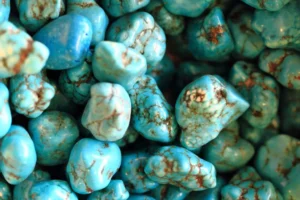
Look closely at two pieces of natural turquoise and you will notice something remarkable. Even if their colours appear similar, their surfaces rarely tell the same story. One may display delicate golden threads, another bold black webbing, while a third appears almost free of visible markings. These intricate patterns are known as the matrix, and they are among the defining characteristics that make natural turquoise one of the world’s most fascinating gemstones.
For experienced collectors, matrix is far more than a visual detail. It is part of the stone’s identity, giving every piece of handcrafted jewelry an appearance that nature will never repeat.
Nature’s Signature Inside Every Stone
Matrix is the network of minerals and host rock that remains within turquoise as it forms underground over vast geological timescales. Rather than being added later, these patterns develop naturally as the gemstone grows within surrounding rock formations.
Because every deposit experiences different geological conditions, no two matrix patterns develop in exactly the same way. This natural unpredictability ensures that every turquoise stone carries its own unmistakable fingerprint.
Not Every Matrix Looks the Same
One of the reasons collectors find turquoise so captivating is the extraordinary variety of matrix patterns. Some stones display fine spiderweb networks stretching evenly across the surface. Others reveal bold veins that create dramatic visual contrast, while certain specimens contain only the faintest traces of their surrounding rock.
These differences should never be viewed as imperfections. Instead, they are evidence of the unique environment in which each gemstone formed. The matrix becomes part of the stone’s character, not a distraction from its beauty.
Why Collectors Appreciate Matrix
Beginning collectors often focus entirely on colour, but experience gradually changes that perspective. Matrix introduces personality into a gemstone, giving it visual movement and individuality that a completely uniform surface cannot always provide.
Many enthusiasts actively seek distinctive matrix patterns because they make a piece immediately recognisable. A beautifully balanced web matrix or an unusual network of natural mineral lines often becomes the feature that transforms attractive jewelry into a memorable collector’s piece.
Matrix Influences Design Choices
Artisans rarely treat matrix as something to hide. Instead, it often becomes an essential part of the design itself.
A bold matrix pattern may inspire a clean sterling silver setting that allows the stone to dominate the composition. A quieter pattern may encourage more decorative silverwork that complements rather than competes with the gemstone. Every artistic decision begins with understanding the personality already present inside the stone.
Rather than forcing turquoise to fit a predetermined design, skilled silversmiths frequently allow the matrix to guide the direction of the finished piece.
Every Deposit Creates Its Own Visual Identity
Collectors soon discover that certain turquoise sources become recognised for characteristic matrix patterns. Some are admired for delicate spiderweb formations, while others are celebrated for bold mineral veining or clean, open areas of vibrant colour.
These naturally occurring differences help explain why turquoise from various mining regions develops loyal followings among collectors. The matrix becomes another way of appreciating the remarkable diversity created by nature long before the artisan begins shaping silver around the gemstone.
Looking Beyond Perfection
One of the greatest misconceptions surrounding turquoise is that less matrix automatically means higher quality. In reality, there is no universal standard that defines the “perfect” amount of matrix.
Some collectors admire clear blue stones with minimal visible markings. Others specifically search for intricate spiderweb patterns because of their rarity and artistic appeal. Personal preference plays a significant role, and exceptional craftsmanship can elevate either style into remarkable jewelry.
The most important consideration is not how much matrix is present, but how naturally it contributes to the overall beauty of the stone and the finished design.
Conclusion
Matrix reminds us that the finest gemstones are products of nature rather than uniform manufacturing. Every line, web, vein, and mineral inclusion reflects geological processes that unfolded over millions of years, giving turquoise an individuality that simply cannot be duplicated.
For Native American artisans, these natural patterns are not obstacles to overcome but creative opportunities to embrace. They inspire original designs, influence artistic decisions, and ensure that every handcrafted bracelet, pendant, necklace, or ring possesses a visual identity found nowhere else. That uniqueness is one of the enduring reasons turquoise continues to hold such a special place in the world of handcrafted jewelry.