Every great work of handcrafted jewelry tells its story through detail. While natural gemstones often attract immediate attention, it is frequently the decorative silverwork that gives Native American jewelry its unmistakable identity. Long before a bracelet is admired for its turquoise or a pendant is appreciated for its elegant proportions, the silver itself has already begun communicating the artisan’s creativity through texture, contrast, movement, and carefully executed ornamentation. Decorative techniques transform sterling silver from a structural material into an artistic canvas capable of expressing remarkable individuality.
These techniques were never developed simply to make jewelry appear more elaborate. Each serves a specific artistic purpose, helping create rhythm, emphasize important design elements, introduce visual depth, or guide the viewer’s eye across the composition. Understanding these methods allows collectors to appreciate the extraordinary thought that exists beyond the polished surface of every handcrafted piece. The more closely these details are observed, the more clearly the artisan’s skill and artistic philosophy become visible.
Hand Stamping Creates Rhythm and Identity
Among the most recognizable decorative methods in Native American jewelry is hand stamping. Rather than treating silver as a smooth, uninterrupted surface, artisans use carefully selected steel stamps to introduce repeating impressions that create movement, texture, and visual balance. Every strike must be placed with confidence because even slight inconsistencies can influence the harmony of the finished composition.
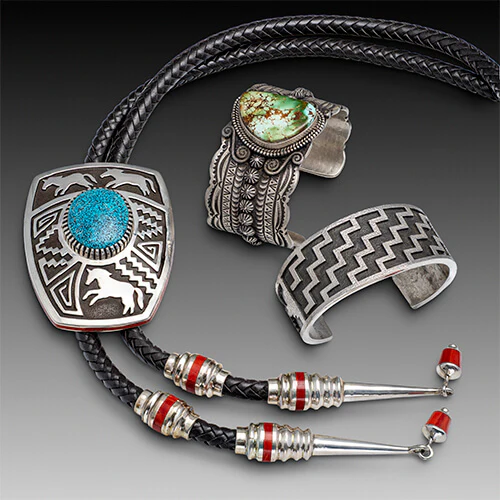
The beauty of hand stamping lies in its versatility. Delicate borders can frame a central gemstone without distracting from it, while bold geometric impressions can transform a wide silver cuff into a dramatic statement of craftsmanship. No two artisans develop identical stamping styles, making this technique an important expression of personal creativity as well as technical ability. Collectors often recognize experienced silversmiths by the confidence, consistency, and rhythm found within their stamped designs.
Engraving Brings Motion to Still Silver
Engraving introduces another dimension of artistry by allowing lines to flow across the surface of the silver with remarkable precision. Unlike stamped impressions, engraved details can vary in depth, direction, and movement, giving artisans greater freedom to create compositions that appear fluid and expressive. Fine engraved lines may gently guide the eye around a gemstone, define decorative borders, or introduce subtle texture that enriches the overall design without overwhelming it.
This technique demands patience and exceptional control. Every line contributes to the visual rhythm of the jewelry, meaning that accuracy is essential from beginning to end. Successful engraving appears effortless because it becomes part of the composition itself rather than standing apart as decoration. The result is jewelry that rewards prolonged observation, revealing increasingly refined details as the viewer looks more closely.
Texture Gives Silver a Living Presence
One of the remarkable qualities of handcrafted jewelry is its ability to interact with light in constantly changing ways. Texture plays a central role in achieving this effect. By deliberately altering the surface of sterling silver, artisans create finishes that reflect, absorb, or diffuse light differently across the same piece. Smooth polished areas may contrast with softly textured backgrounds, creating depth that changes naturally as the jewelry moves.
Texture also influences the emotional character of a design. Highly polished silver communicates elegance and clarity, while softly textured surfaces introduce warmth and visual complexity. Combining different finishes within the same composition allows artisans to emphasize particular elements without relying on additional ornamentation. This thoughtful manipulation of surface quality demonstrates how subtle artistic decisions can dramatically influence the personality of a finished piece.
Oxidation Creates Contrast and Depth
One of the most effective ways to emphasize decorative detail is through the careful use of oxidation. By intentionally darkening selected recessed areas of the silver, artisans create contrast that allows engraved patterns, stamped impressions, and layered designs to stand out with greater clarity. This interplay between light and dark strengthens the overall composition, making decorative elements easier to appreciate without increasing visual complexity.
The effectiveness of oxidation depends upon restraint. Applied thoughtfully, it enriches the design while allowing polished silver to remain the primary visual focus. Excessive use can overwhelm a composition, but balanced application creates a sense of depth that encourages closer examination. Collectors often appreciate oxidation because it quietly enhances craftsmanship without drawing unnecessary attention to itself.
Relief Techniques Add Dimension Without Excess
Some decorative methods introduce physical depth by raising or lowering selected areas of silver while preserving the overall balance of the design. These relief techniques allow artisans to create sculptural effects that catch light naturally and encourage visual exploration from multiple angles. Rather than decorating every available surface, relief work directs attention toward carefully chosen elements, giving the composition structure and movement.
What makes these techniques particularly impressive is their subtlety. The changes in height may be modest, yet they significantly influence how the finished jewelry is experienced. Shadows become part of the artwork, polished surfaces gain greater prominence, and decorative forms appear more dynamic as the piece responds to changing light. The silver itself begins to communicate with the viewer through form rather than ornament alone.
Decorative Techniques Work Best Together
Exceptional Native American jewelry rarely relies upon a single decorative method. Instead, artisans thoughtfully combine stamping, engraving, texture, oxidation, relief work, and refined finishing to create compositions where every technique supports the others. The objective is never to display technical ability for its own sake. It is to produce jewelry in which every decorative decision contributes to unity, balance, and artistic expression.
This harmonious integration explains why remarkable handcrafted pieces continue revealing new details long after their first viewing. A collector may initially notice a beautifully shaped bracelet, then later appreciate the precision of its stamp work, the elegance of its engraved borders, the subtle contrast created through oxidation, and the carefully balanced textures that bring the silver to life. Each observation deepens appreciation because every decorative element serves a meaningful purpose within the larger composition.
Looking Beyond Decoration
Understanding decorative silver techniques changes the way Native American jewelry is experienced. What first appears to be ornament gradually becomes evidence of artistic judgement, technical confidence, and years of disciplined practice. Every carefully placed impression, every engraved line, every textured surface, and every subtle contrast reflects decisions that transformed raw silver into an expressive work of art.
The greatest decorative techniques never compete with the jewelry itself. They strengthen its identity, enrich its visual language, and reveal the remarkable creativity of the artisan. By learning to recognize these details, collectors develop a deeper appreciation for the craftsmanship that defines Native American jewelry and the enduring artistic traditions that continue to shape its extraordinary beauty.